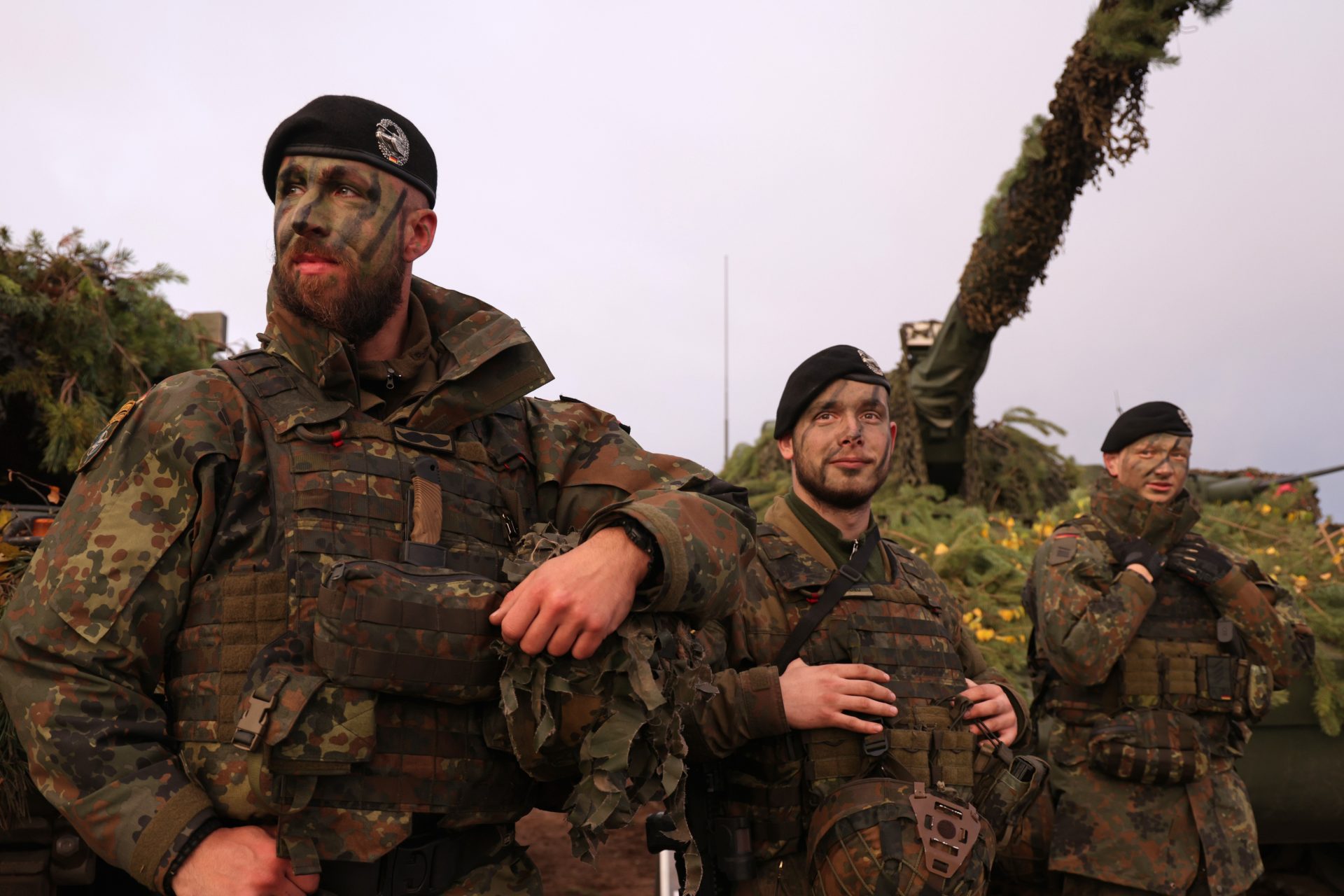
A heavy downpour blankets Rukla, a former Soviet army complex just north of Vilnius, while German Leopard 2A8 tanks and a convoy of NATO infantry fighting vehicles crawl through the mire, their hulls disguised with fir branches. A Norwegian lieutenant, Robin Eskeland, remarks on the Germans' strict adherence to timetables and the value of joint training in such conditions. Since 2017 Germany has headed a multinational NATO force in Lithuania, but the full‑scale Russian invasion of Ukraine in 2022 prompted Vilnius to demand firmer security guarantees. In response, Berlin announced the permanent stationing of the 45th Panzer Brigade – the Bundeswehr's first standing overseas formation since the end of World War II – to act as a deterrent on NATO's northeastern flank. The brigade carries its own heraldry: a black Staufer lion beside a sword and the silhouette of Vilnius’s Gediminas Tower, set against the green, red, black and gold of the German and Lithuanian flags. Its arsenal includes state‑of‑the‑art Leopard 2A8 main battle tanks, Puma IFVs, Panzerhaubitze 2000 self‑propelled howitzers and a fleet of kamikaze drones, with more than 700 drones slated for flight tests next month. Strategically, the unit is tasked with safeguarding the Suwałki Gap – the narrow land corridor linking the Baltic states with the rest of NATO – and represents a doctrinal shift. Rather than a small “tripwire” force that would merely delay an aggressor, NATO now aims to field heavy armor ready to repel an attack from the outset. Fuente: UnHerd #NATO #Lithuania #Germany #BalticDefense #Military #Tanks #Europe
También lo cubren: UnHerd (Reino Unido).
Ver más en News Today